You spend hours on a launch email. The offer is solid, the design looks right – and then Gmail mangles the layout, Outlook ignores half your CSS, and a chunk of your list never even gets it. Meanwhile other brands are quietly pulling five figures from their last campaign. That gap? It’s almost never about the copy. It’s about whether there’s a real email marketing strategy underneath or just vibes and a send button.
The brands performing well in 2026 aren’t “sending newsletters.” They’re running systems – behavior-triggered, authenticated, mobile-tested, dark-mode-ready systems that combine automation with design that doesn’t fall apart when it hits a real inbox. They’re getting more out of fewer emails while everyone else is guessing.
This guide covers how to build an email marketing strategy that’s conversion-focused, technically sound, and built to survive inbox rules that keep changing.
- Why you need a solid email marketing strategy in 2026
- ROI is only real if your email marketing strategy has a foundation
- The one-size-fits-all email is dead
- Inbox rules now decide if your email marketing strategy pays off
- Mobile and dark mode can break your design before a subscriber even reads it
- Setting clear goals for your email marketing strategy
- Understanding your audience
- Why personas can miss the point
- Zero-party and first-party data – your new advantage
- Segmentation that drives revenue
- Interactivity as a data-collection tool
- Building your email list the right way
- Lead magnets that trigger action – not just sign-ups
- Double opt-in: your first quality filter
- Compliance isn’t just legal cover – it protects deliverability
- Choosing the right email marketing platform
- Match your platform to your mission
- Test before committing – actually test
- Crafting compelling email content that drives action
- Hook from the subject line
- Make it about them, not you
- Structure for scanning
- Personalization beyond the first name
- Optimizing email design and user experience
- Mobile-first is the baseline, not the goal
- Dark mode can destroy your CTAs
- Accessibility extends your reach
- Use animation where it earns its place
- Leveraging AI and automation for smarter email marketing campaigns
- Predictive segmentation in practice
- Behavior-triggered flows vs. calendar-based drips
- AI-assisted content at scale
- Compliance and deliverability essentials
- Authentication is non-negotiable
- Keeping sender reputation clean
- Compliance as a subscriber experience tool
- Measuring, analyzing, and optimizing your email marketing strategy
- Track the metrics that are actually reliable
- Test with a hypothesis, not a coin flip
- Optimization as an ongoing habit, not a launch activity
- Future trends shaping your email marketing strategy
- AI-built personalization at real scale
- Interactive emails as the inbox itself becomes a conversion surface
- Deliverability requirements will keep tightening
- Privacy-first data collection
- Quiz to test your knowledge
Why you need a solid email marketing strategy in 2026
ROI is only real if your email marketing strategy has a foundation
Email delivers around $36 for every $1 spent – that figure comes from Litmus research and has been cross-confirmed by Statista, HubSpot, and others. But that number belongs to the people who understand what they’re doing. Without proper strategy – technical implementation, subscriber segmentation, consistent testing – your returns drop fast, and you’re basically paying to annoy people.
A solid email campaign strategy turns your list from a spreadsheet of addresses into a predictable revenue channel. The distinction isn’t how many emails you send; it’s whether those emails are doing something intentional.
The one-size-fits-all email is dead
Sending the same message to your entire list is leaving money on the floor. Modern strategies run on behavior-triggered sequences – emails that go out when someone browses a product, stalls in a welcome flow, or shows purchase signals. AI has made this more precise: it can catch micro-signals like an about-to-be-abandoned cart or a customer behaviorally ready for an upsell, and it can act on those signals before the moment passes.
Inbox rules now decide if your email marketing strategy pays off
Deliverability isn’t an IT problem. Gmail, Outlook, and Apple Mail have been enforcing SPF, DKIM, and DMARC authentication, and senders who skip them don’t land in spam – they bounce, or worse, they damage their domain reputation permanently. Your email marketing strategy has to treat authentication as infrastructure, not an afterthought.
Mobile and dark mode can break your design before a subscriber even reads it
More than 50% of email opens happen on mobile – figures from multiple sources put this between 41-65% depending on the dataset and how Apple MPP opens are counted, but mobile-first is clearly non-negotiable. Dark mode complicates things further: roughly 34% of emails are actually viewed in dark mode (per 2022 data from Litmus), and while exact current figures vary by client and audience, the trend is upward. Wrong color choices – transparent logos on dark backgrounds, light text on light backgrounds when a client inverts – can make CTAs vanish entirely.
A smart email marketing strategy builds mobile-first, dark-mode-aware design in from the start.
Setting clear goals for your email marketing strategy
Picture this: two weeks on an email campaign, sent to 20,000 people, and the report comes back with a 0.8% click rate. Your boss asks what the goal was, and the honest answer is something like “…sales, I guess.” That’s how most strategies die – not bad copy or a broken template, but no actual objective.
A strong email marketing strategy ties campaigns to specific, measurable business outcomes:
- Increase monthly recurring revenue by 20% from email within six months – specific enough to shape content, cadence, and CTA decisions.
- Lift click-through rates on automated sequences from 2% to 4% before Q3 – a testable, ownable target.
- Reactivate 15% of inactive subscribers this quarter – with a clear definition of “inactive” so you know when you’ve hit it.
One principle worth holding onto: one email, one objective. A newsletter tested with three CTAs (“Shop Now,” “Follow Us,” “Read the Blog”) produced a 0.9% click rate. The same list with a single focused CTA jumped to 3.4%. Diluted attention means diluted results.
Understanding your audience
Why personas can miss the point
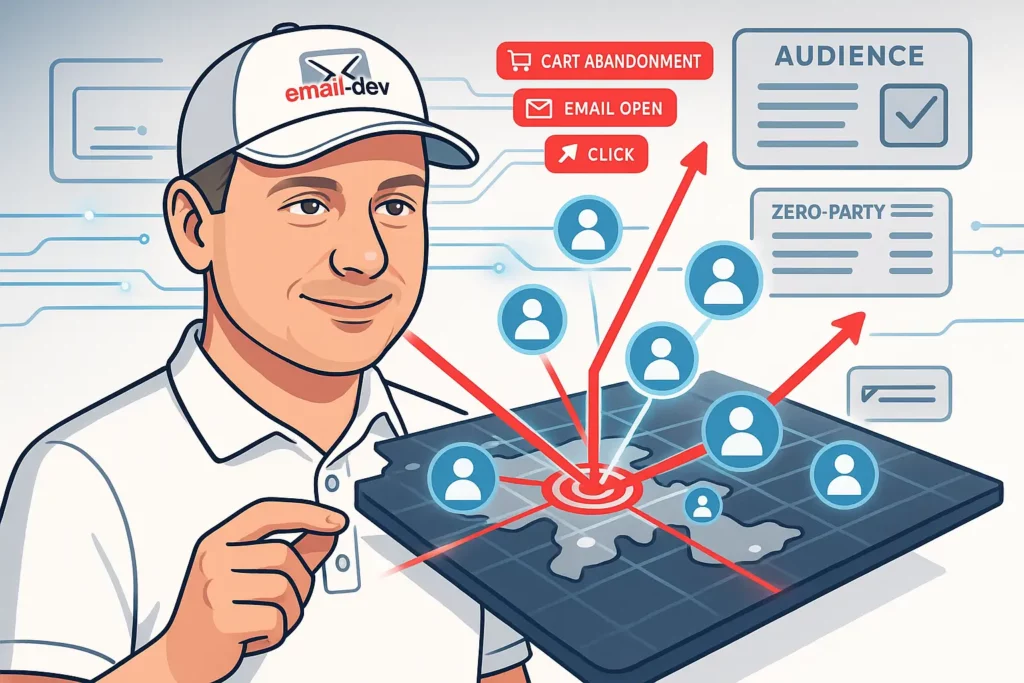
That “Women 25-45 interested in self-improvement” persona? Half of them may have already bought what you’re pitching. The other half might have no interest in this week’s offer. Generic personas give you a false sense of targeting while you’re still broadcasting.
A real email campaign strategy uses behavior-driven data, not demographic sketches.
Zero-party and first-party data – your new advantage
Third-party cookies are mostly gone. Privacy laws tightened. This makes the data you collect yourself more valuable, not less.
- Zero-party data: subscribers tell you directly – through surveys, preference centers, quizzes – what they want.
- First-party data: their behavior tells you – what they clicked, what they browsed, how recently they bought.
The combination is where the precision lives. “They clicked this product category link” plus “they told us they want outdoor gear” is targeting that demographic profiles can’t replicate.
Segmentation that drives revenue
The most profitable email strategies segment on behavior and lifecycle stage, not on demographics:
- Behavioral segmentation – based on what they did (purchased, browsed, downloaded, clicked a specific link).
- Lifecycle segmentation – new subscribers get welcome series, active buyers get upsell sequences, churning customers get win-back flows.
- Predictive segmentation – AI identifies who’s likely to buy, who needs a nudge, who’s probably about to unsubscribe.
Switching an abandoned cart segment from “everyone who abandoned” to “high-value customers who abandoned” can radically change revenue per email. The broader segment might be noisier and lower-converting than you’d expect.
Interactivity as a data-collection tool
Most brands still send static emails. Interactive elements – polls, in-email surveys, product preference quizzes – generate engagement data you can actually act on. AMP-powered forms in email have shown significantly higher survey response rates compared to linked landing pages in various tests. More importantly, every interaction feeds more precise targeting for what comes next.
Building your email list the right way

A bad list can destroy a year’s worth of sender reputation work in two weeks. Buying contacts – “targeted” or otherwise – is a fast path to deliverability problems: hard bounces signal to inbox providers that you’re sending to invalid addresses, spam complaints hammer your sender score, and recovery from a serious reputation hit can take months.
If the list isn’t built on consent and genuine intent, everything else in your email marketing strategy is fighting an uphill battle.
Lead magnets that trigger action – not just sign-ups
Most lead magnets collect email addresses that never engage. The problem isn’t lead magnets as a concept – it’s that most of them solve a “someday” problem. A 20-page eBook about email strategy is something people download and forget. A 5-minute dark mode fix for broken email templates solves something right now.
Think about what your target subscriber needs this week, not eventually:
- A launch-day checklist for course creators.
- A one-click tool to estimate campaign ROI.
- A specific template that solves a known display problem in a specific ESP.
The difference in both opt-in rates and downstream conversion can be significant when the lead magnet addresses an immediate, concrete pain point.
Double opt-in: your first quality filter
Skipping double opt-in to “keep more sign-ups” tends to backfire. Single opt-in lists typically show lower open rates, higher unsubscribe rates, and more spam complaints – all of which feed into deliverability scores. Double opt-in filters out people who didn’t genuinely want to hear from you, and the people who do confirm are meaningfully more engaged.
Cleaner list → better deliverability → more of your emails actually land. The math on conversion ends up better even with a smaller confirmed list.
Compliance isn’t just legal cover – it protects deliverability
Gmail, Outlook, and Yahoo require SPF, DKIM, and DMARC for bulk senders. Missing DNS records can cause campaigns to bounce before they ever touch a spam folder. Your list-building process should include:
- GDPR/CAN-SPAM compliance baked in from the start, not retrofitted.
- Clear, working unsubscribe links in every email.
- Timestamped consent records – if you ever need to demonstrate compliance, you’ll be glad you kept them.
Choosing the right email marketing platform
Choosing an ESP based on how nice the templates look tends to result in a platform migration every 12 months. The tool has to fit your actual email campaign strategy – including the automations you need, the integrations with your stack, and the deliverability infrastructure.
Match your platform to your mission
If you’re clear on your use case, the choice gets simpler:
- E-commerce: Klaviyo’s Shopify/WooCommerce integration and real-time behavioral data are hard to beat at scale.
- Advanced automation: ActiveCampaign’s behavioral triggers and lead scoring handle complex conditional sequences well.
- All-in-one for small teams: Mailchimp covers email, landing pages, and some ad management in one place.
- Creators and course sellers: ConvertKit’s (now Kit) tagging system and product sales features were built for audience-first businesses.
Test before committing – actually test
Two platforms can both say “automation” and mean completely different things. One means “send an email 3 days after sign-up.” The other means “send this email if they clicked X, haven’t visited Y in 7 days, and their lifetime value is above Z.”
Before signing up, run a quick stress test:
- List your top 3 required automations.
- Verify the platform can execute them natively without third-party workarounds.
- Check independent deliverability test results – 97%+ inbox placement is a reasonable benchmark.
The wrong platform choice doesn’t just cost money. It creates technical debt that limits what your email marketing strategy can actually do.
Crafting compelling email content that drives action
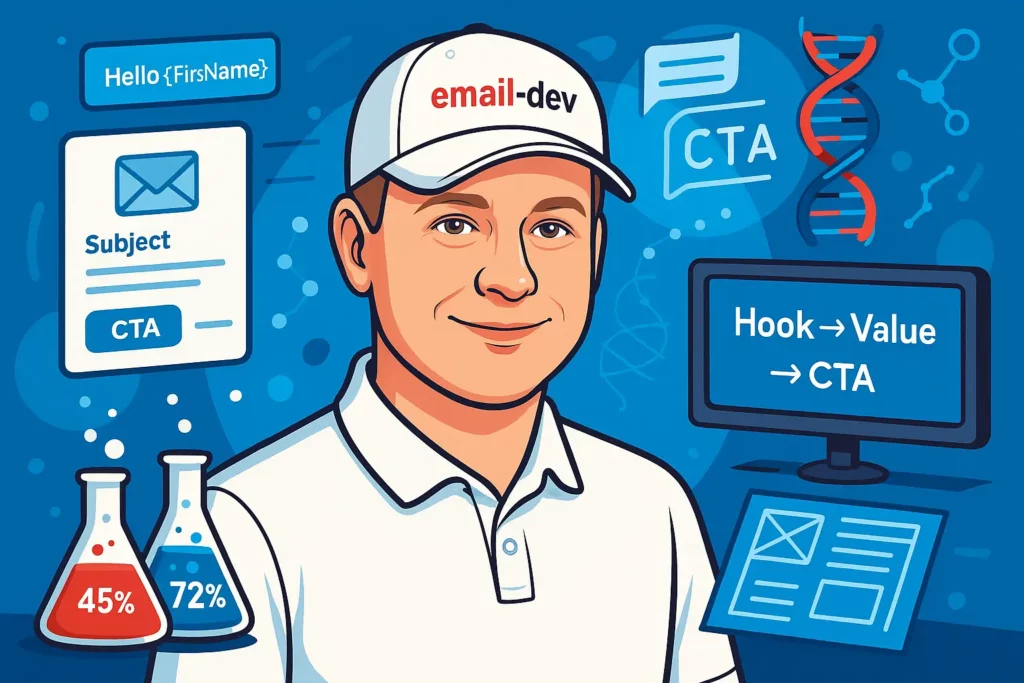
A campaign with professional copy and a clean design still fails if every sentence is about the sender instead of the reader. In a working email marketing strategy, content is built around the subscriber’s specific problem, urgency, and next step – not around a brand’s news or product updates.
Hook from the subject line
“Our latest update is here” is a subject line that tells the subscriber nothing about why they should care. Subject lines that perform tend to spark curiosity, create urgency, or signal direct relevance:
- E-commerce: “Your cart expires in 3 hours.”
- Creators: “This one habit triples course completion rates.”
- B2B: “How we cut client onboarding time by 48%.”
A retail client that switched from “Summer sale is on” to “Prices drop at midnight” saw opens rise 29% and clicks jump 42%. Subject line framing matters more than most people give it credit for.
Make it about them, not you
Instead of: “We’ve updated our platform with new features.”
Try: “You can now send a formatted email in 3 minutes – even when Gmail keeps fighting back.”
The first sentence is about the company. The second is about what the subscriber can do. One of them gets clicked; the other gets skimmed and forgotten.
Structure for scanning
Most subscribers open on mobile, probably while doing something else. If the offer is buried in paragraph five, most of them never reach it.
A scannable email structure:
- Hook (1-2 lines) – immediate relevance or tension.
- Value (the benefit, fix, or insight) – why it matters to this subscriber.
- CTA (single, clear, specific) – what they should do next.
If your email campaign strategy genuinely needs multiple offers in one send, use clearly distinct sections or separate sends.
Personalization beyond the first name
Behavior-based personalization moves the needle meaningfully:
- E-commerce: product carousels based on browsing history.
- Creators: content recommendations tied to completed or abandoned course modules.
- B2B: case studies matched to the subscriber’s industry or company size.
A fashion retailer switching to “based on your last purchase” product recommendations saw revenue per email increase 41%. Personalization tied to actual behavior consistently outperforms demographic targeting.
Optimizing email design and user experience
Mobile-first is the baseline, not the goal
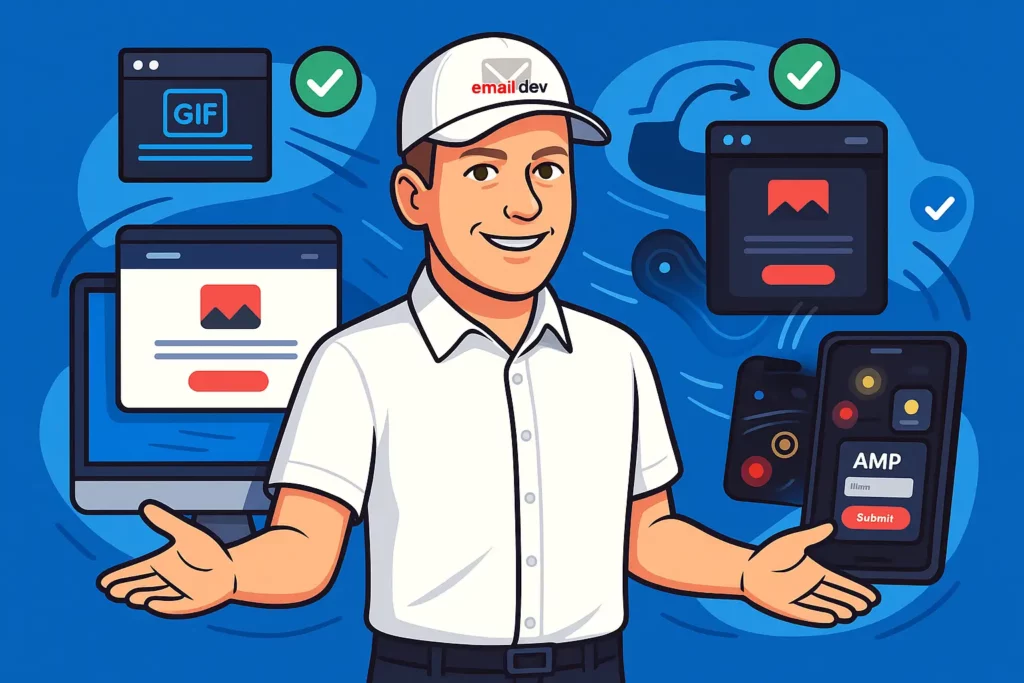
With 50%+ of opens on mobile (across most audience types), design starts with mobile constraints:
- Single-column layouts for predictable rendering.
- Buttons at least 44px tall – this is Apple’s minimum tap target guideline, and it matters.
- Images compressed for sub-5-second load times.
A practical test: can you tap your own CTA without zooming in? If not, your subscribers can’t either.
Dark mode can destroy your CTAs
A significant portion of your subscribers – estimates vary, but approximately a third of email opens happen in dark mode based on available data – are viewing emails in dark mode. The specific rendering behavior differs by email client: some invert everything automatically, some do nothing, some partially transform colors. The result is that a CTA button that looks perfect in your preview can become invisible or unreadable in dark mode on a specific client.
Fixing contrast issues in dark mode takes testing in real email clients (Litmus and Email on Acid both handle this). A CTA that vanishes in dark mode is a conversion that never happened.
Accessibility extends your reach
Alt text, adequate color contrast, and screen reader-compatible structure aren’t just good practice – they meaningfully expand the audience that can engage with your emails. People with visual impairments, color blindness, or situational constraints (bright outdoor glare, one-handed reading) all benefit from accessible design. Accessible email templates typically require very little additional development effort and are worth building into your standard process.
Use animation where it earns its place
GIFs and animations can lift engagement when they support the message. A countdown timer in a flash sale email adds urgency. A looping background animation in a B2B nurture email distracts without adding value and can actually reduce conversions. The question to ask: does this animation support the CTA, or is it just decoration?
Leveraging AI and automation for smarter email marketing campaigns
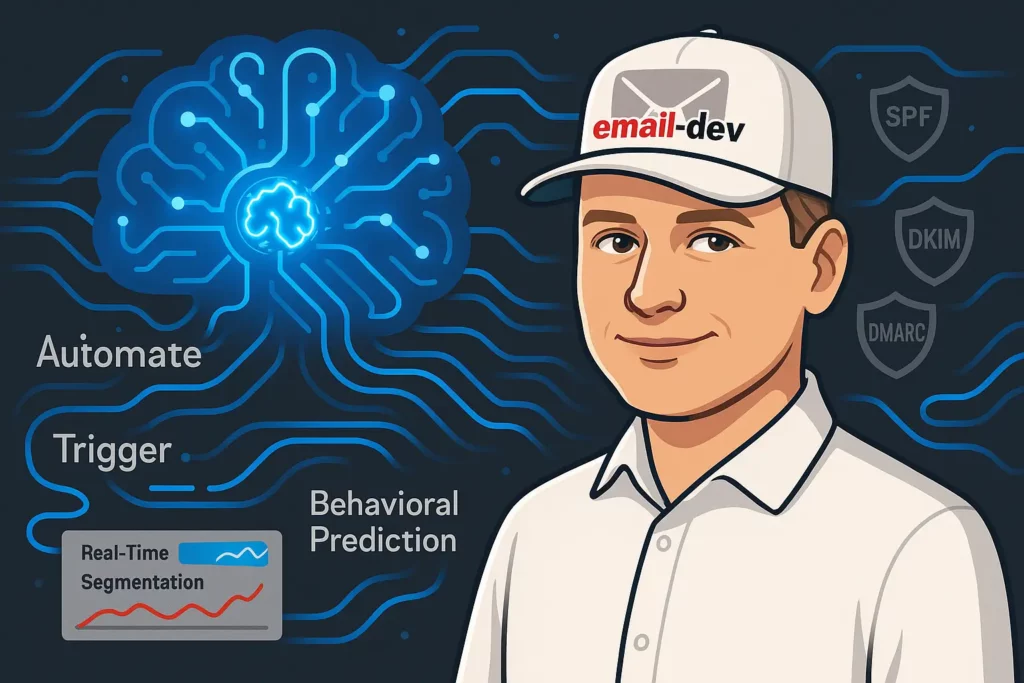
AI’s role in email marketing has shifted from experimental to practical. The most useful current applications aren’t about generating copy (though that’s part of it) – they’re about timing, segmentation, and identifying purchase intent before you’d otherwise know it.
Predictive segmentation in practice
A retail campaign that focused send volume on the subset of subscribers AI predicted as most likely to purchase can generate a disproportionately high percentage of total revenue from that smaller group. Predictive segmentation works by identifying behavioral patterns – recency, frequency, category affinity – that correlate with purchase intent, and prioritizing those subscribers for high-value sends.
This applies across contexts:
- E-commerce: detect likely cart abandonment before it happens and send the relevant offer.
- Creators: identify students who are at risk of dropping off and intervene with a relevant lesson or bonus.
- B2B: flag accounts showing buying-cycle signals and accelerate their nurture track.
Behavior-triggered flows vs. calendar-based drips
A rigid “send after X days” automation loses sales because it sends at the wrong time for the wrong people. Someone who signs up and immediately clicks through to a pricing page is not the same subscriber as someone who signed up and hasn’t engaged since. Sending them the same generic 3-day follow-up email ignores everything their behavior is telling you.
Behavior-triggered flows adjust in real time:
- A welcome series that branches based on what a new subscriber clicks.
- An onboarding sequence that skips steps the subscriber has already completed.
- A re-engagement campaign that stops immediately when the subscriber buys.
When a static 7-day drip is replaced with dynamic behavioral triggers, free-to-paid upgrade rates routinely improve. The exact lift varies, but the direction is consistent.
AI-assisted content at scale
Generative AI can build dynamic subject lines, product recommendation blocks, and segment-specific body copy. The practical key is training it on your actual best-performing campaigns – not just asking it to “write an email.” Feed it 10-15 of your top performers with explicit notes on what worked, and the output will reflect your voice and approach, not generic AI prose.
Compliance and deliverability essentials
The most sophisticated automation is worthless if emails don’t reach the inbox. Deliverability is a core pillar of any working email marketing strategy, and the requirements have only tightened.
Authentication is non-negotiable
Gmail, Outlook, and Yahoo require:
- SPF and DKIM aligned with your sending domain.
- A DMARC policy (starting with p=none while you monitor, moving toward quarantine or reject as you gain confidence).
- One-click unsubscribe headers for bulk senders.
A single misconfigured DNS record can kill an entire campaign. Black Friday sends have bounced before touching a spam folder because DMARC wasn’t set up correctly. Check these before every major campaign, not just at initial setup.
Keeping sender reputation clean
Every send contributes to your domain’s score with inbox providers:
- Remove inactive subscribers every 3-6 months – keeping unengaged contacts drags down engagement rates, which affects deliverability.
- Avoid sudden volume spikes, particularly with new or warmed domains.
- Keep complaint rates below 0.1% – Gmail’s threshold for elevated filtering is around this level.
Importing a large cold list – especially without proper warming – can tank deliverability for active subscribers who were already engaging. The damage is real and recovery takes time.
Compliance as a subscriber experience tool
Treating compliance requirements as engagement design leads to better outcomes:
- A frequency selector at sign-up lets subscribers choose how often they hear from you – this typically reduces unsubscribes substantially.
- Immediate unsubscribe processing, not “up to 10 business days.”
- A preference center where subscribers can change topic interests rather than facing an all-or-nothing unsubscribe.
Engaged subscribers signal to inbox providers that your emails are wanted. That signal is the single most important factor in sustained deliverability.
Measuring, analyzing, and optimizing your email marketing strategy
The send is the start, not the end. The real leverage in a modern email marketing strategy comes from what you measure, what you test, and what you change based on what you find.
Track the metrics that are actually reliable
With Apple Mail Privacy Protection affecting a significant portion of open tracking – Apple accounts for roughly 47-52% of email opens by current Litmus data, and most Apple Mail users have MPP enabled – open rate has become an unreliable primary metric. The metrics worth prioritizing:
- Click-through rate (CTR): the percentage of delivered emails where someone clicked a link. Industry average is around 2% across all sectors; B2B tends to land between 1.67-3.18% and e-commerce varies widely by niche.
- Conversion rate: are clicks translating into purchases, sign-ups, or bookings?
- Revenue per email (RPE): even a small lift per subscriber compounds significantly at scale.
- Unsubscribe and complaint rates: rising complaint rates are an early warning of content fatigue or targeting problems. Keep complaints below 0.1%.
Test with a hypothesis, not a coin flip
Random A/B tests burn time without producing actionable knowledge. Start with a specific question:
- “Does urgency framing in subject lines lift CTR for this segment?”
- “Does a single product offer outperform a product grid in our abandoned cart email?”
- “Does adding a testimonial improve purchase rate for first-time buyers?”
Testing button colors while leaving offer structure and copy untouched tends to produce noise, not insight. The variables that move revenue most – offer clarity, CTA placement, the presence or absence of social proof – are worth testing before aesthetic details.
Optimization as an ongoing habit, not a launch activity
Evergreen automation flows decay. Copy that resonated 18 months ago may be stale. Onboarding sequences built for a product that has since changed are actively hurting conversion.
- Review onboarding flows quarterly based on drop-off analytics.
- Refresh abandoned cart copy at least every quarter with new hooks and current social proof.
- Rotate CTAs in newsletters to counter the click-fatigue that builds when subscribers see the same button repeatedly.
Re-testing and updating a trial-to-paid upgrade sequence every quarter rather than setting it once and forgetting it is the kind of practice that compounds into significant year-over-year conversion improvement.
Future trends shaping your email marketing strategy
AI-built personalization at real scale
The direction AI is heading is toward assembling emails in real time for individual subscribers – unique subject line, copy, product set, and even layout, assembled seconds before delivery based on current behavioral signals. The practical implication: “personalization” will mean something fundamentally different in two years than it does today.
Interactive emails as the inbox itself becomes a conversion surface
AMP for Email and other interactive protocols let subscribers complete forms, answer polls, and (increasingly) complete purchases without leaving the email client. Reducing friction between email engagement and conversion has measurable impact on drop-off rates. The challenge is that client support is still uneven – AMP has strong support in Gmail but limited elsewhere – which means interactive elements need fallbacks for non-supporting clients.
Deliverability requirements will keep tightening
Inbox providers are moving toward placement decisions based on engagement signals rather than volume. This rewards senders who maintain clean, engaged lists and penalizes volume-focused strategies. Domain alignment, low complaint rates, and genuine engagement will matter more, not less.
Privacy-first data collection
Zero-party and first-party data are becoming the only reliable targeting foundation as third-party data disappears and privacy regulations expand. Brands that build clear value exchanges – “tell us what you care about and we’ll send you what’s relevant” – will maintain targeting precision. Brands that don’t will be working with less and less signal over time.
A future-proof email marketing strategy isn’t measured by email volume. It’s measured by how systematically you learn from each send, how precisely you can target the next one, and how well your technical infrastructure keeps your emails arriving in the first place.
Quiz to test your knowledge
Let’s play! To solidify what you have learned, take a short quiz.
Results